✦ COUNTDOWN TO APRIL 6, 2027 ✦
“Benedetto sia ‘l giorno, et ‘l mese, et l’anno, / et la stagione, e’l tempo, et l’ora, e ‘l punto…” — Rvf 61
“Benedetto sia ‘l giorno, et ‘l mese, et l’anno, / et la stagione, e’l tempo, et l’ora, e ‘l punto…” — Rvf 61
"così m'ha fatto Amor"(Rvf. 170.11)
Love has made me this way
“così m’ha fatto Amor”(Rvf. 170.11)
“Love has made me this way”
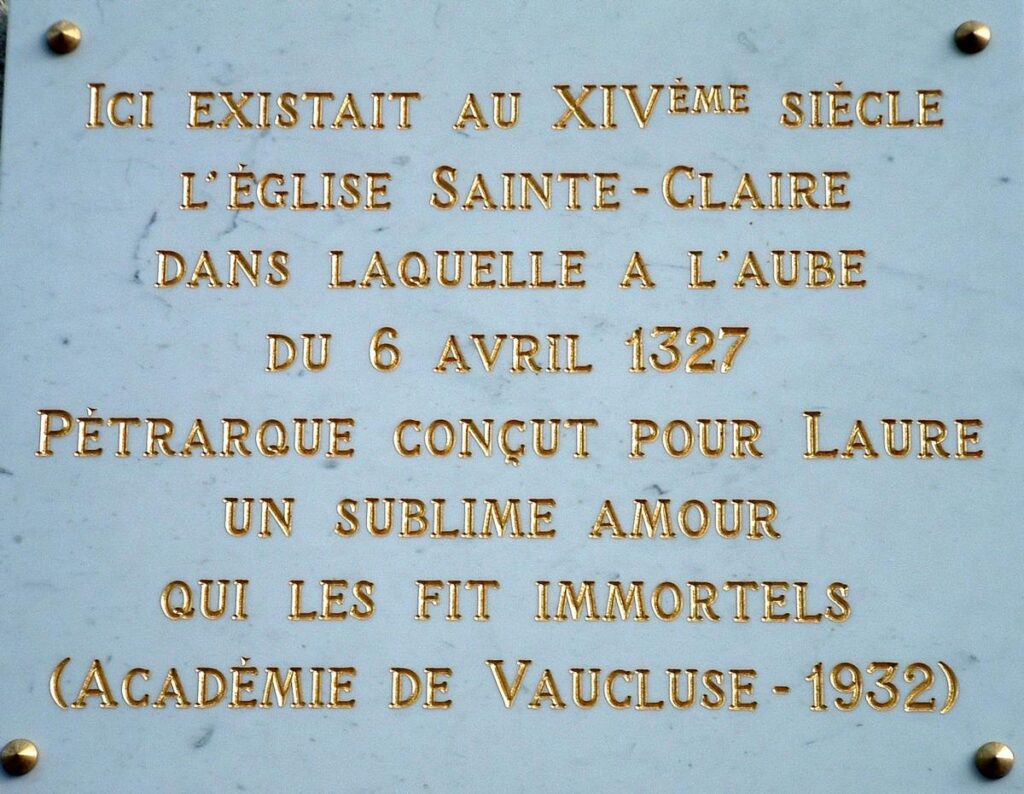
On April 6th, 1327, at the beautiful Church of Saint Claire (Chapelle Sainte-Claire church; commemorative plaque) in Avignon, France—now, fittingly, a theater incorporated into the Théatre des Halles—a dramatic moment arrests Petrarch, freezing him upon the spot and making time seem to come to an immediate halt: across a crowded room, during Easter mass, he has caught sight of a lovely lady whose beauty instantaneously wins his heart. He falls in love, and is slaked through with longing and frustration, exhilaration and pain, a desire to write and a desire to weep.
“così m’ha fatto Amor”(Rvf. 170.11)
“Love has made me this way”
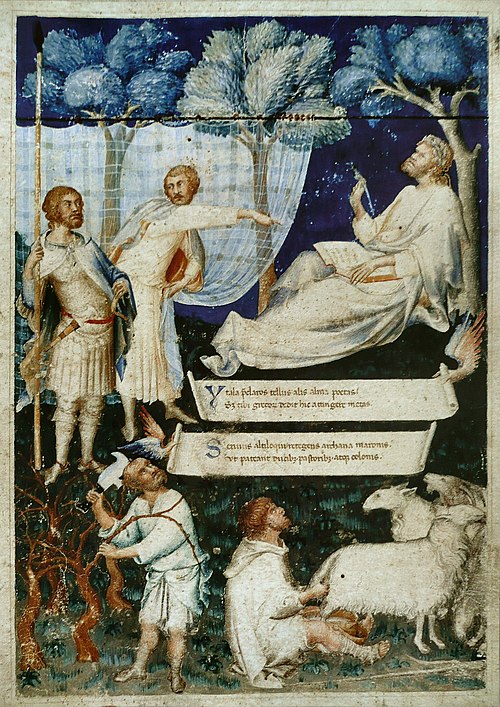
The Ambrosian Virgil
This is also the story Petrarch mournfully recounts in a heart-rending note he writes in his copy of a volume of Virgil (the Ambrosian Virgil; picture). In this gorgeous manuscript, helpfully annotated by Petrarch himself, on a flyleaf comment in which he emphasizes his long artistic and emotional labors to preserve Laura in verse, he points out the painful coincidence of seeing his beloved for the first time on an April 6th, and the date of her tragic death in 1348, “at the same hour of the same 6th of April.” These dates gain further poignancy with the important religious implications of their exact correspondence with the date of Christ’s crucifixion.
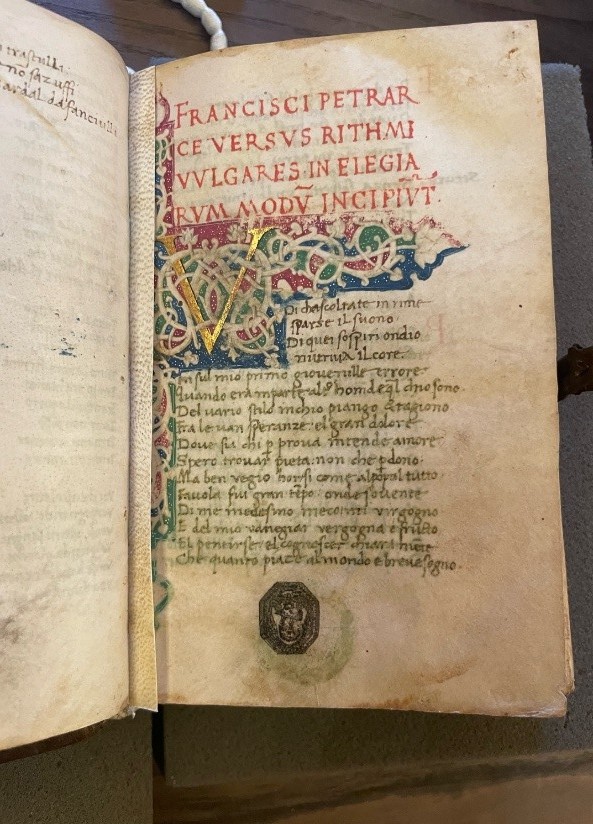
Biblioteca Capitolare, Verona,Taken on an Archival Trip – Opening Sonnet, “Voi ch’ascoltate in rime sparse il suono”
The Ambrosian Virgil: A Heart-Rending Note
This is also the story Petrarch mournfully recounts in a heart-rending note he writes in his copy of a volume of Virgil (the Ambrosian Virgil; picture). In this gorgeous manuscript, helpfully annotated by Petrarch himself, on a flyleaf comment in which emphasizes his long artistic and emotional labors to preserve Laura in verse, he points out the painful coincidence of seeing his beloved for the first time on an April 6th, and the date of her tragic death in 1348, “at the same hour of the same 6th of April.” These dates gain further poignancy with the important religious implications of their exact correspondence with date of Christ’s crucifixion.
Petrarch concludes his note in the Ambrosian Virgil with a valediction to Laura and to any possible happiness without Laura, which recalls the concluding verse of the Rvf’s proemial lament: “che quanto piace al mondo è breve sogno”(Rvf.1.14 “that everything pleasing to the world is a brief dream”).
“To write these lines in bitter memory of this event, […] has in it something of a cruel sweetness, but I forget that nothing more ought in this life to please me.”
— Petrarch, concluding his note in the Ambrosian Virgil
This website will consequently offer a meditation on Petrarch’s negotiation of time, which is an important throughline in all of his work. Most simply, however, given the significance of the April 6th anniversary dates, Petrarch’s own passion for commemoration, and Petrarch’s foundational role in lyric poetry and humanistic thought, this website offers a countdown and a trajectory through Petrarch’s vernacular Canzoniere by offering a poem per day, beginning April 5th, 2026. In questa passa ‘l tempo” (Rvf.168.14 “In this way time flies,” Kline), as Petrarch writes.
Thus, daily, we may tick off the hours as we move towards April 6th, 2027, the 700th anniversary of Petrarch’s claims to have first seen his beloved.
About Me

Stomping around the Lijnbaansgracht, to take a peek at the “Triomf van de faam overde dood” (The Triumph of Fame over Death; see under images), and other great works of art related to the lauded poet at the Rijksmuseum, in Amsterdam
About Me
Impassioned by the sonnet form, I am a poet, translator, and Assistant Professor of Comparative Literature, French and Francophone Studies, and Hispanic Studies at Brown University, where I enjoy teaching courses on critical theory and on medieval and early modern literature. I am officially affiliated with the Department of Italian Studies, Medieval Studies, the Center for the Study of the Early Modern World, the Institute at Brown for Environment and Society, and the Center for Global Antiquity, and I am one of Brown’s Faculty Consortium and Executive Committee Representatives to the Folger Shakespeare Library.
I co-convene Brown’s Disability Studies Working Group, and I co-chair the Renaissance Studies Seminar at Harvard’s Mahindra Humanities Center. I am on the Executive Committee of the Rocky Mountain Medieval and Renaissance Association, and I am one of the Co-editors-in-Chief of postmedieval: a journal of medieval cultural studies, and I am a dedicated reader of all genres of Petrarch’s work, from his Latin epic and invectives to the lyric poetry featured here.
My research focuses on gender, race, and disability in premodern literature. In my teaching and writing, I give close attention to epic and lyric poetry, especially on the Petrarchan oeuvre and the early origins of the love lyric, Petrarchism, and Boiardo, Ariosto, and Tasso. I also tend to prioritize medieval and early modern drama, particularly around the issues of marriage, health, disability, and race in early modern tragedy. I enjoy studying exemplarity and classical intertexts as they resonate during the medieval and early modern periods, and I dedicate a good deal of time to premodern women’s writing and the (proto)feminist complaint tradition.
On Petrarch, I try to give equal attention to his brilliant Latin works and the watershed moment(s) that his lyric poetry represents. His work is a cornerstone of my forthcoming book on autobiographical discussions of premodern disability. Of late, I have been especially excited by his representation of the natural world, which I have been reading through an ecocritical lens; his portrayal of medicine and the physical symptomology of lovesickness; and his construction of an authorial voice and the citational and intertextual practices he uses to do so, alongside those of premodern women authors and Petrarchan poets. I have also recently written on wounds and the archive in Petrarch’s letters and poetry and on the representation of race in his epic and lyric poetry.
Stay tuned, and thanks so much for your interest!
"To write these lines in bitter memory of this event, has in it something of a cruel sweetness..."
— Petrarch, Ambrosian Virgil