✦ COUNTDOWN TO APRIL 6, 2027 ✦
“Benedetto sia ‘l giorno, et ‘l mese, et l’anno, / et la stagione, e’l tempo, et l’ora, e ‘l punto…” — Rvf 61
“Benedetto sia ‘l giorno, et ‘l mese, et l’anno, / et la stagione, e’l tempo, et l’ora, e ‘l punto…” — Rvf 61
Lives and Lyric
"Lasso, che son! che fui!" — (Rvf 23.30) · “Alas, what am I? What was I?” (Kline).
Francesco Petrarca (Petrarch)
1304 – 1374 · Arezzo to Arquà
"Lasso, che son! che fui!" — Alas, what I am! what I was!
Francesco Petrarca, known in English as Petrarch, was an Italian scholar, poet, and one of the earliest humanists. Born in Arezzo in 1304, he spent much of his childhood in Avignon, where his father worked at the papal court. Trained in law, Petrarch soon abandoned legal studies for literature and classical antiquity, becoming a tireless searcher for forgotten Latin manuscripts.
The Canzoniere & Lyric Innovation
Petrarch’s vernacular masterpiece, the Rerum vulgarium fragmenta (or Canzoniere), is a collection of 366 poems — predominantly sonnets, many of which are addressed to Laura, or are about her — a woman he first saw on April 6, 1327. Through this sequence, Petrarch invented a new kind of lyric poetry: introspective, psychologically complex, and obsessed with memory, desire, and the passage of time. The Canzoniere became the model for love poetry across Europe for centuries (Petrarchism).
"Voi ch'ascoltate in rime sparse il suono
di quei sospiri ond'io nudriva 'l core..." — (Rvf 1.1-2)
"You who hear the sound, in scattered rhymes,
of those sighs on which I fed my heart..."
— (Kline)
Latin Works & Humanism
Petrarch considered — or at least often claimed — that his Latin writings were more significant than his vernacular poetry: for example, his magisterial epic Africa (on Scipio Africanus), the biographical De viris illustribus, and his private letters collected in Rerum familiarium libri. He was crowned Poet Laureate in Rome in 1341, an honor reviving classical tradition. Petrarch’s passion for recovering classical texts, his dedication, and ardent study of them, contributed to his titular, rather honorific reputation as the “Father of Humanism.”
Time, Fugacity & Commemoration
Petrarch’s fixation on time marks all his work. In his copy of Virgil (the Ambrosian Virgil), he famously recorded both the day first catching sight of Laura (April 6, 1327) and her death (April 6, 1348), writing: “To write these lines in bitter memory of this event […] has in it something of a cruel sweetness.” He died in Arquà in 1374, right before what would have been his 70th birthday, and left behind a transformed literary landscape.
“ma se ’l latino e ’l greco/parlan di me dopo la morte, è un vento” (Rvf 264.69-70)
“and if Latin or Greek/ speak of me after death, it is mere air” (Kline)
1304Born in Arezzo, Italy
1327April 6: First sees Laura in Avignon
1341Crowned Poet Laureate in Rome
1348Laura dies during the Black Death
1374Dies in Arquà, leaving various texts unfinished
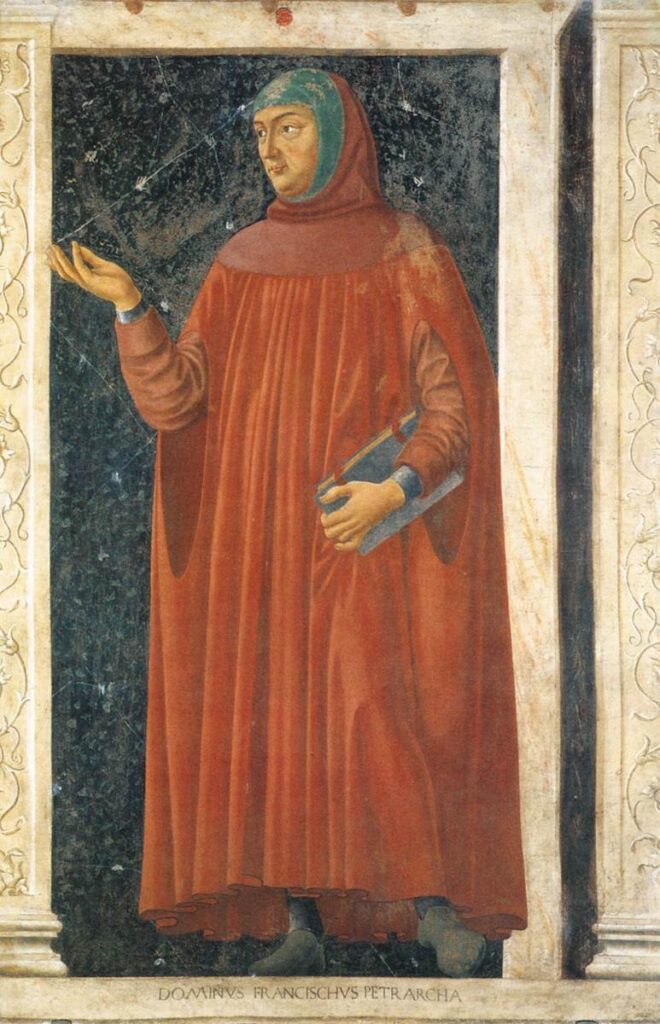
Andrea del Castagno, “Francesco Petrarca,” particolare del Ciclo degli uomini e donne illustri, affresco, 1450, Galleria degli Uffizi, Firenze.
Laura (Laura de Noves?)
c. 1310 – 1348 · Avignon
"...del dolce mio mal prima radice" (Rvf 321.5) — the root of my sweet suffering
Laura is the muse of Petrarch’s Canzoniere — the woman he first glimpsed in the Church of Sainte-Claire in Avignon on April 6, 1327. Her identity remains uncertain, though many scholars identify her as Laura de Noves, wife of Count Hugues de Sade. Petrarch himself cultivated the ambiguity surrounding her identity, tangibility, and her direct impact on both his life and his poetry, making her a figure both real and symbolic, singular and iconographic, representative of a poetic ideal and amorous defeat: the alluring and deviating earthly beloved who becomes an abstracted poetic and eternal ideal.
The Lady of the Canzoniere
Laura appears in many of the 366 poems — in nearly 320, depending upon the count. Broadly speaking, in the first part (in vita), she appears as a living woman whose beauty and virtue inspire both joy and torment, inspiration and deviation. Regarding the second part (in morte), many have understood that she becomes a spiritual guide, leading Petrarch toward repentance and transcendence, though this remains a pointed matter of debate (and interpretation). Her name itself is a pun on l’aura (the breeze), l’aria (air and breeze), l’oro (gold), l’alloro and lauro (laurel tree, laurel wreath, poetic excellence), linking her to poetic glory.
"Erano i capei d'oro a l'aura sparsi
che 'n mille dolci nodi gli avolgea..." (Rvf 90.1-2)
"She let her gold hair scatter in the breeze,
that twined it in a thousand sweet knots..." (Kline)
Love at First Sight (“a prima vista”) & Eternal Memory
Petrarch’s description of falling in love at first sight during Easter mass became a cataclysmic literary moment that fanned the flames of the passion described throughout the Canzoniere, and powered the long tradition of Petrarchism that was to supervene. Throughout Petrarch’s collection, Laura is both praised and criticized for her chastity, virtue, and grace — qualities that distance her from Petrarch, and render her impervious to his advances, all while fueling the yearning and desire that encouraged his poetic labour. Although he is worried that he will lose the impetus to create if he loses her entirely, after her death, Laura appears to the poet in dreams and visions. She continues to inspire Petrarch’s poetry and even urges Petrarch toward heaven. Much like the Canzoniere’s first poem, “Voi ch’ascoltate,” in which the poet, full of repentance, insists that he is different man (at least “in parte”) from the person he once was, and that he is ashamed and embarrassed by the youthful folly (the “giovanil’ errore”) that caused him to fall in love with Laura in the first place, the final poem of the Canzoniere (Rvf 366) is a prayer to the Virgin Mary Vergine Bella” (Beautiful Virgin). Thus, the secular love story concludes with sacred longing and a firmly articulated desire for “peace” (“pace”).
“Uno spirito celeste, un vivo sole
fu quel ch'i'vidi: et se non fosse or tale,
piagha per allentar d'arco non sana.” (Rvf.90.12-14)
“A celestial spirit, a living sun
Was what I saw: and if she is not such now,
The wounds not healed, although the bow is slack.” (Kline)
The Historical Question
Whether the moment of innamoramento marked a “real” event, and whether or not Laura was a real woman with personal, historical relevance to Petrarch, or purely a literary construct and poetic abstraction continues to intrigue readers. Petrarch’s note in the Ambrosian Virgil testifies to a real woman whose death he mourned. Yet Laura also functions as a poetic fiction — an idealized beloved whose inaccessibility generates infinite verse. This duality lies at the heart of Petrarchan love poetry and undergirds many of the binaries, contradictions, and affective extremes that Petrarchan desire has come to represent.
"Death of the lady, not love; end of the body, not the beloved." — Laura’s death transforms Petrarch’s poetry into a meditation on immortality through verse.
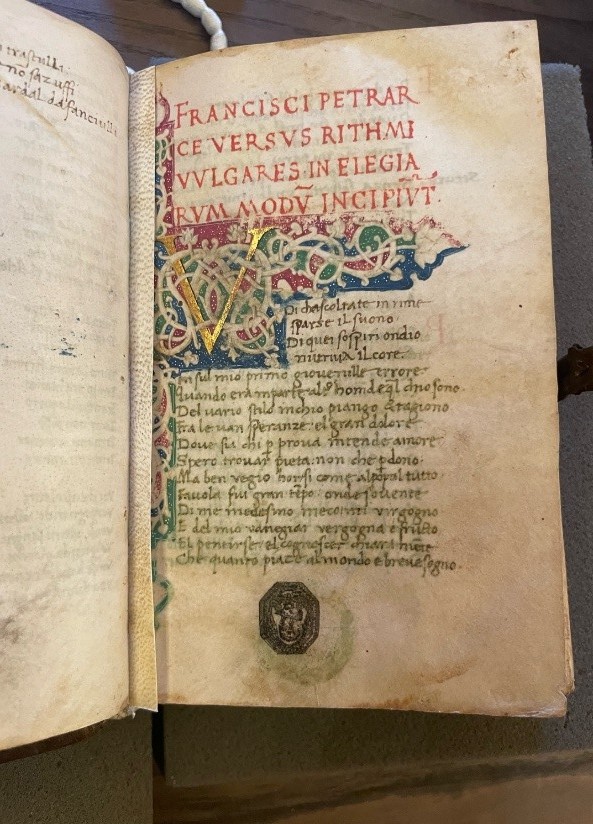
Biblioteca Capitolare, Verona,Taken on an Archival Trip – Opening Sonnet, “Voi ch’ascoltate in rime sparse il suono”
Love at First Sight: The Moment of Transformation
On April 6, 1327, at the Church of Saint Claire in Avignon, during Easter mass, Petrarch saw Laura. In that instant, time seemed to stop — and the Western lyric tradition was forever changed.
Chapelle Sainte-Claire, Avignon (now Théâtre des Halles)
April 6, 1327 → April 6, 1348 → April 6, 2027
700 Years
"Era il giorno ch'al sol si scoloraro" — Rvf 3
O del dolce mio mal prima radice,
ov’è il bel viso, onde quel lume venne
che vivo et lieto, ardendo mi mantenne?
Sol’ eri in terra; or se’ nel ciel felice.
Et m’ài lasciato qui misero et solo,
talché pien di duol sempre al loco torno
che per te consecrato honora et còlo; (Rvf. 321.5-11)
O the first root of my sweet ills,
where is the lovely face, living and joyful
from which that light came that set me burning?
You, unique on earth, are happy in heaven.
And you have left me wretched and alone,
so that grief-filled I always turn to honour
and adorn that place that you made sacred: (Kline)
The poetic biographies of Petrarch and Laura are inseparable from the construction and composition of Petrarch’s vernacular poetry itself — each “life” and each “poetic afterlife” refracted through verse, each moment preserved for seven centuries.
End of the Body, Not the Beloved
After Laura’s death in 1348, Petrarch continued to write poems addressing her — now as a spirit in heaven. The second half of the Canzoniere (Rvf 267–366) explores grief, repentance, and the hope of reunion. Laura becomes immortal through poetry, a theme that resonated across Renaissance Europe. This site honors that tradition: each poem keeps the memory alive, counting towards the 700th anniversary of that first, transformative glance, and towards the 700th anniversary of that first, transformative day.