✦ COUNTDOWN TO APRIL 6, 2027 ✦
“Benedetto sia ‘l giorno, et ‘l mese, et l’anno, / et la stagione, e’l tempo, et l’ora, e ‘l punto…” — Rvf 61
“Benedetto sia ‘l giorno, et ‘l mese, et l’anno, / et la stagione, e’l tempo, et l’ora, e ‘l punto…” — Rvf 61
Petrarch: A Life in Time
“…et le cose presenti et le passate/ mi dànno guerra, et le future anchora”(Rvf.272.3-4)
“…and present things and past things/ embattle me, and future things as well” (Kline)
From exile in Arezzo to the poetic crown in Rome — from the first glimpse of Laura to the quiet death in Arquà. This timeline traces the 70 years of Francesco Petrarca's extraordinary life, marking the moments that shaped the Father of Humanism and his enduring Canzoniere.
1304
Born in Arezzo
1327
First sees Laura
1341
Poet Laureate in Rome
1348
Laura dies
1374
Dies in Arquà
1302
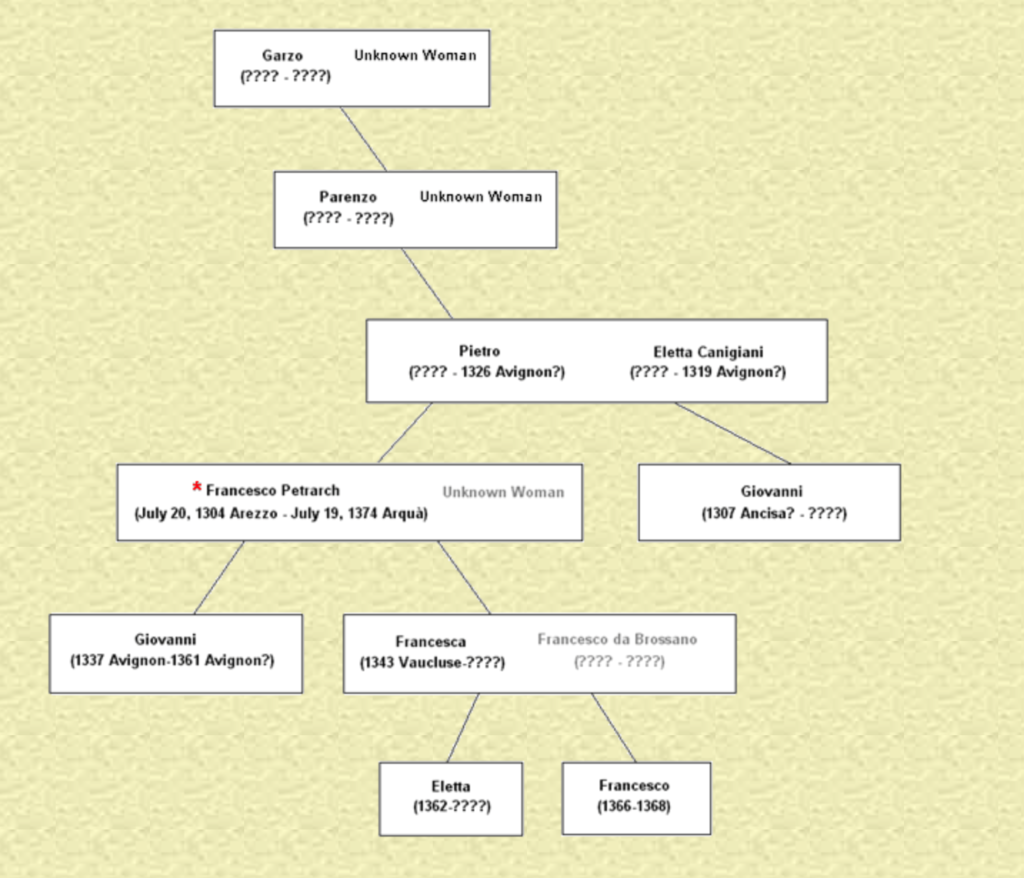
Petrarch’s father, the notary Pietro di Parenzo di Garzo (Ser Petracco dell’Incisa; c.1266-1326), is exiled from Florence, Italy
1304
Petrarch was born “in exile” in the Comune of Arezzo (about 50 miles to the south of Florence) at dawn.
1305
Petrarch and his mother moved to Ancisa (Incisa in Val d’Arno), roughly 12 miles to the southeast of Florence; this is the region where Petrarch would grow up.
1307
Petrarch’s brother Gherardo is born. Petrarch also has a sister, Selvaggia.
1310
The woman believed to be Petrarch’s beloved, Laura de Noves (d.1348; also, Laure de Safe), daughter of the Knight Audibert de Noves, is born in Avignon.
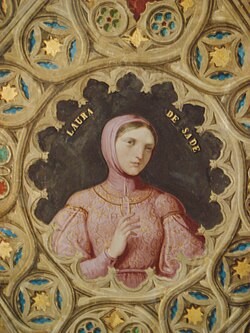
Laure de Sade, Wall Painting, Fresco, trompe l’oeil, Villa Torlonia, Rome.
1312
Petrarch’s family moves to Avignon, and then to the nearby Carpetras, where Petrarch begins his first studies.
1315
Laura de Noves marries Huges II de Sade.
1316
Petrarch begins his legal studies in Montpellier.
1318
Eletta Canigiani, Petrarch’s mother dies. Petrarch writes a moving lament in her honor (Metrica I.7), which becomes one of his earliest extant poems.
1320
In this year, Petrarch pursues his legal studies in Bologna alongside his brother Gherardo. Petrarch has little interest in law, due to his “insatiable thirst” for literature, but he is ordered to pursue it by his father; (he definitively abandons law only after his father’s death.)
1321
Petrarch’s father marries Niccolosa di Vanni Sigoli.
1324
Petrarch’s sister Selvaggia marries Giovanni di Tano da Semifonte
1325
Laura de Noves marries Huges II de Sade, a wealthy Avignonese merchant. The couple would have 11 children.
1326
Petrarch’s father dies in Avignon; Petrarch returns to Avignon. Petrarch took minor ecclesiastical orders under Cardinal Giovanni Colonna (1295-1348); this relationship would lead to Petrarch holding an especially important role for his educational development during the 1330s. Colonna became a close supporter who would feature in Petrarch’s poetry; their friendship came to an end in 1346 due to political differences.
1327
On April 6th, Good Friday, Petrarch sees the person who he would claim as his beloved Laura (believed to be Laura de Noves/Laure de Sade) for the first time in Avignon’s church of Sainte-Claire, during Easter Mass. This momentous instant of falling in love, a cataclysmic moment of “innamoramento,” which he describes as delightful, painful, and a harm that catches him unawares (“del tutto disarmato”), would be imagined and reimagined across many of the 366 poems that constitute his Canzoniere (Rvf; Songbook; Scattered Rhymes).
It was likewise a theme that he grappled with in many of his Latin letters, worrying both about his (unreciprocated) love for Laura, and about the vanity involved in the task of writing love poetry at all. He would work on the Canzoniere continuously, from first seeing Laura to the end of his life.
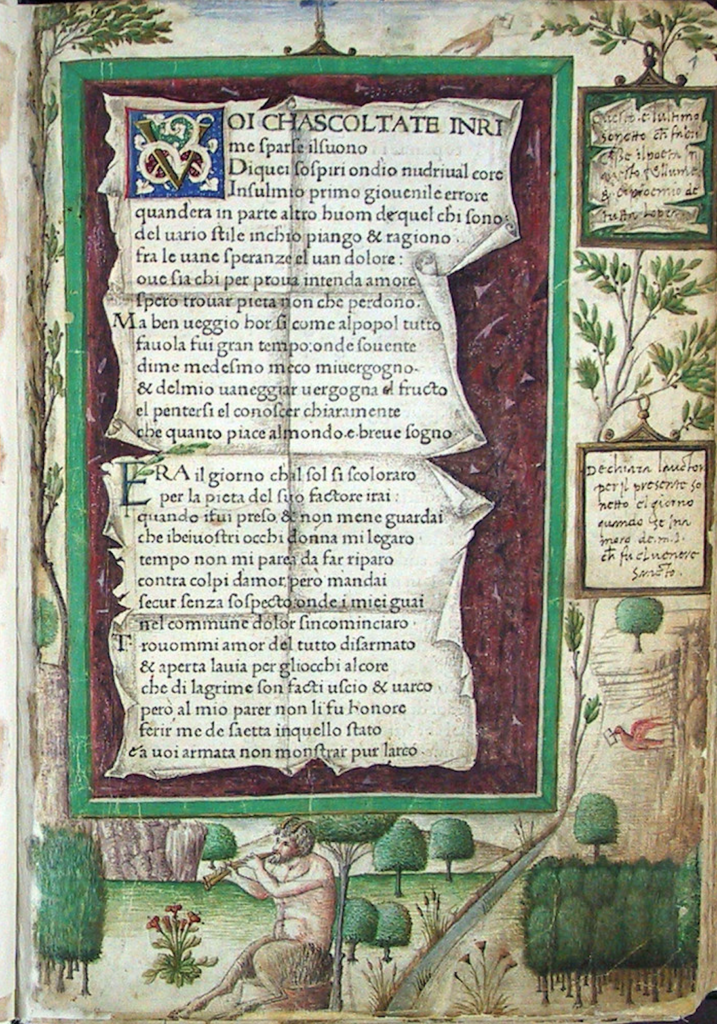
Manuscript illustration of “Voi ch’ascoltate” (Rvf. 1) and “Era il Giorno ch’al sol si scoloraro” (commonly Rvf.3). Published by Vindelino da Spira, illustrated by Antonio Grifo, 1470, Biblioteca Civica Queriniana of Brescia.
1330
Petrarch’s traves take him to Lobez and Toulouse.
1333
Petrarch travels widely, going to Paris, where his friend Dionigi of Sansepolcro gives him a copy of Augustine’s Confessions; he would later thank Dionigi for this gift in his “Ascent of Mont Ventoux” (see year 1336).
Petrarch also visits Flanders, Amsterdam, Brabant, and the Rhineland. He also goes to Liège, where he finds speeches by Cicero (the Pro Archia); he travels to Ghent, Aix-la-Chapelle, and Cologne as well.
1336
In what would come to mark a watershed moment in humanistic thought, Petrarch climbs Mont Ventoux (“not improperly called the Windy Mountain,” Petrarch writes). Now somewhat associated with the Tour de France, this mountain is located in Provence, near Capentras, in the department of Vaucluse.
Petrarch was accompanied by his brother and guides, all of whom were able to reach the top of the mountain with relative ease, while he struggled greatly. Petrarch describes having longed to climb the mountain for quite a while before he makes the decision to do so:
(“I have had the expedition in mind for many years; for, as you know, I have lived in this region from infancy, having been cast here by that fate which determines the affairs of men. Consequently, the mountain, which is visible from a great distance, was ever before my eyes, and I conceived the plan of some time doing what I have at last accomplished today.”
(From “The Ascent of Mont Ventoux, to Dionisio da Borgo San Sepolcro” Robinson Translation; [Source: Hanover Historical Texts Project, Hanover College])
He describes carrying with him a small copy of Augustine’s Confessions, from which he reads as he ascends the mountain.
While some of the poems included in the Canzoniere date from 1327, when he first saw Laura, Petrarch began to seriously work on the collection sometime between 1336 and 1338.
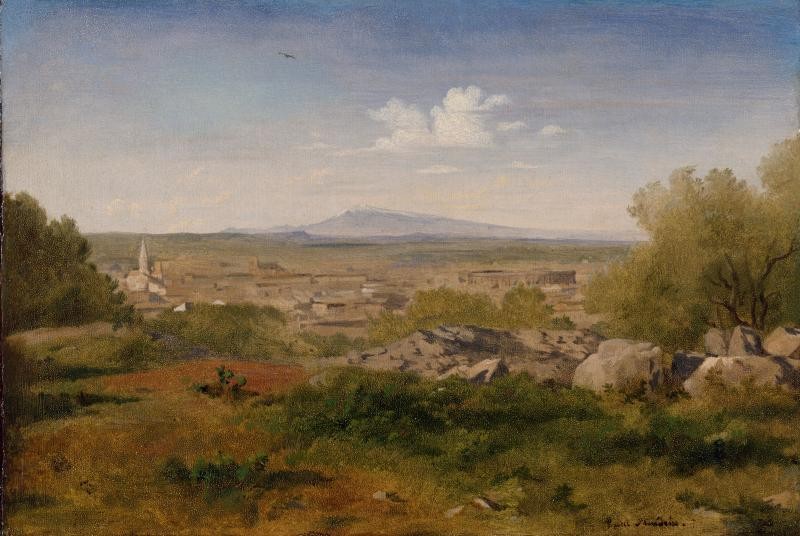
Paul Flandrin, “View of Orange and Mont Ventoux,” Oil on paper, mounted to canvas, 1842. The Morgan Library & Museum.
1337
Petrarch travels to Rome for the first time. He is hosted by the nobleman Orso dell’Anguillara and his wife, Agnese Colonna; Orso would later go on to crown Petrarch during a ceremony to honor him as Poet Laureate in 1341. Petrarch’s son Giovanni, with whom he would have a conflictual relationship, is born in Avignon.
1338/9
Petrarch begins to write what he considered to be his masterwork, the Africa, the epic poem, which, alongside other Latin works, secured his literary reputation and won him the poetic crown, the laurel wreath. The epic, which recounts the feats of Scipio Africanus, is incomplete.
Petrarch begins to write De viris illustribus (On Illustrious Men), a Plutarchian- and Ciceronian-styled unfinished work containing a collection of Latin biographies on the achievements of ancient, biblical, and mythological men.
1340
In a momentous happenstance, Petrarch essentially receives simultaneous offers to be crowned Poet Laureate in Paris or in Rome. He chooses Rome.
1341
Another momentous poetic April event! On Easter Sunday, April 8th, after passing an examination by King Robert of Naples, Petrarch was crowned Poet Laureate in Rome by Orso dell’Anguillara, the Roman nobleman, who had hosted Petrarch during his first trip to the city in 1337.
The speech Petrarch pronounces at this event is the “Collatio laureationis” or the “Coronation Oration,” exalting the values and worth of the classical tradition, and emphasising the learning ancient texts still offer, while musing about intertextual and socioliterary connections, and the endurance of literary fame.
The ceremony, which bedecked Petrarch with the laurel wreath on Rome’s Capitoline Hill, was intended to honor Petrarch as a writer of Latin material (his epic the Africa, in particular), and distinctly not for his lyric vernacular love poetry.
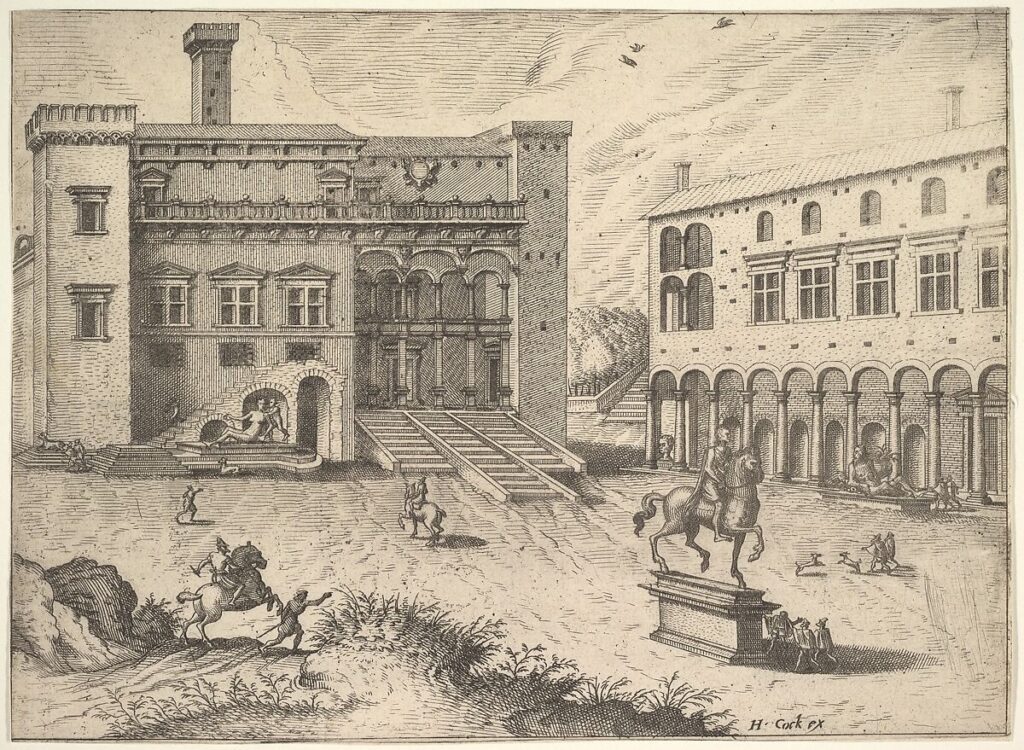
View of the Campidoglio on the Capitoline Hill, with equestrian statue at lower right, from The Operum antiquorum romanorum, “The Small book of Roman ruins and buildings,” Johannes van Doetecum I, etching, 1562
1342
Petrarch writes the Rerum memorandarum libri (Book on Matters to be Remembered), a moralizing series on the virtues, historical examples, and moral education, left incomplete.
1343
Petrarch returns to Avignon after spending time in Rome and Parma after his Coronation. Petrarch writes his Psalmi poenitentiales (Penitential Psalms) and the Secretum (The Secret), a series of imagined dialogues between himself and St. Augustine.
Petrarch’s daughter Francesca is born. Petrarch’s brother, Gherardo, becomes a Carthusian monk—a reason providing some of the rationale behind writing the Secretum.
1345
Petrarch discovers an important collection of Cicero’s letters at the Biblioteca Capitolare, or Chapter Library of Verona.
His incredible discovery revivifies the proximity he feels towards Cicero and fuels his interest in collecting his own letters as well, which he began with the Familiares and his later Seniles.
He writes a moving letter to Cicero, explaining how he looked for his letters for a very long time, seeking them assiduously. He happened upon them gratefully, and only where and when he least expected.
Poignantly referring to Cicero as “his Cicero,” he concludes the letter thusly:
“Farewell, forever, my Cicero. Written in the land of the living; on the right bank of the Adige, in Verona, a city of Transpadane Italy; on the 16th of June, and in the year of that God whom you never knew the 1345th.” (From Petrarch’s Letter “To Marcus Tulius Cicero,” Robinson Translation; [Source: Hanover Historical Texts Project, Hanover College])
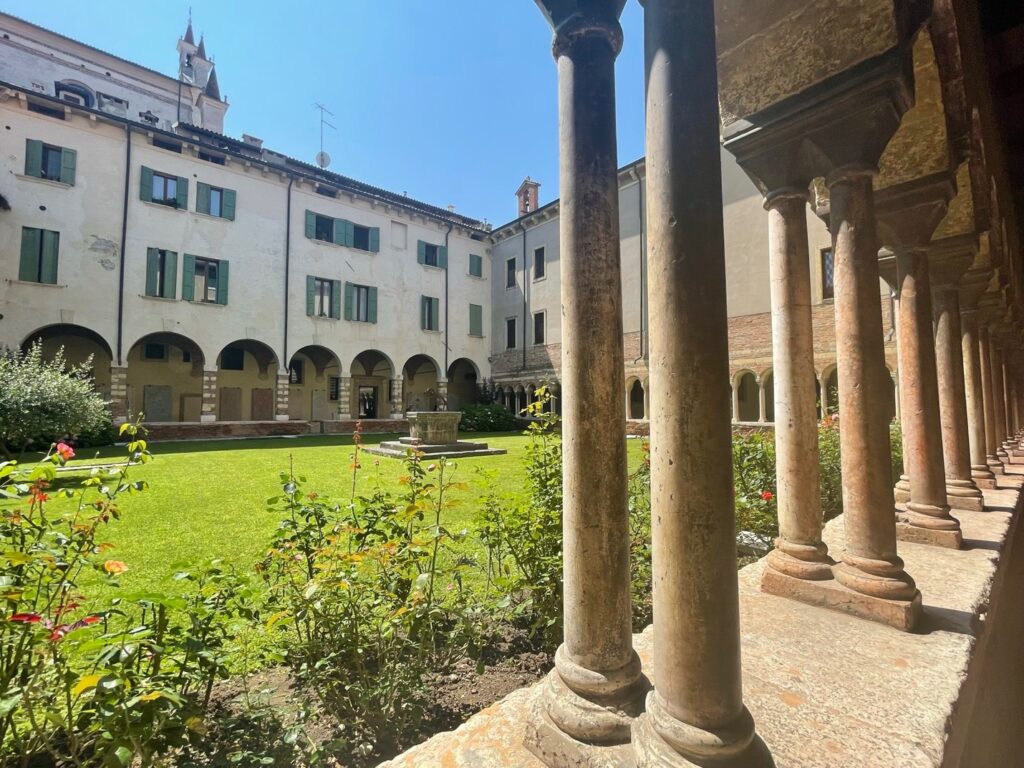
View of the Inner Courtyard of the Chiostro dei Canonici (Cloister of the Canons), in Piazza Duomo—part of an architectural unit that includes the Museo Canonicale (Canonical Muesum) and the Biblioteca Capitolare (Chapter Library). Taken on an Archival Visit to the Biblioteca Capitolare.
1346
Petrarch writes his philosophical treatise, De vita solitaria (On the Solitary Life), a meditative treatise on the necessity of solitude to the contemplative life. In the original, this work is written in Latin and divided into two books. Petrarch dedicates this work to his good friend Philippe de Cabassoles (1305-1372), the Bishop of Cavaillon and Seigneur de Vaucluse, to whom he was grateful for treating him kindly, “like a brother.”
“Petrarch writes De vita solitaria a treatise composed of two books and dedicated to Philippe de Cabassoles, bishop of Cavaillon.
Also writes Bucolicum carmen. Poem in 12 eglogues. Each poem deals with a different topic, among others, an allegory of Petrarch’s poetic crowning (no. 3), the plague of 1348 (no. 9) and the death of Laura (no. 10).”(Sadlon)
1347
Petrarch writes a treatise in two books, De otio religioso (On Religious Leisure).
1348
On April 6th, Good Friday, Laura de Noves (Laure de Sade) dies, perhaps due to the plague or an illness experienced postpartum.
On July 3rd, in Avignon, Giovanni Colonna dies of the plague, in Avignon.
1350
Petrarch makes a pilgrimage to Rome to celebrate the Jubilee year.
Petrarch and Giovanni Boccaccio (1313-1375), the youngest of Italy’s “tre corone” or “three crowns,” and famed author of the Decameron, meet for the first time.
Boccaccio considered Petrarch one of his most important literary models and idol; he describes Petrarch visiting him in a dream at the start of Book 8 of his De casibus virorum illustrium, (On the Fates of Famous Men, 1373). Dream-Petrarch encourages Boccaccio’s work, and assuages Boccaccio’s concerns and weariness about writing being such a difficult enterprise. (See the image gallery for “Boccaccio’s Vision of the Laurel-Crowned Petrarch,” a manuscript illustration of this scene).
The two would meet in person upon additional occasions; they became good friends and frequently exchanged letters.
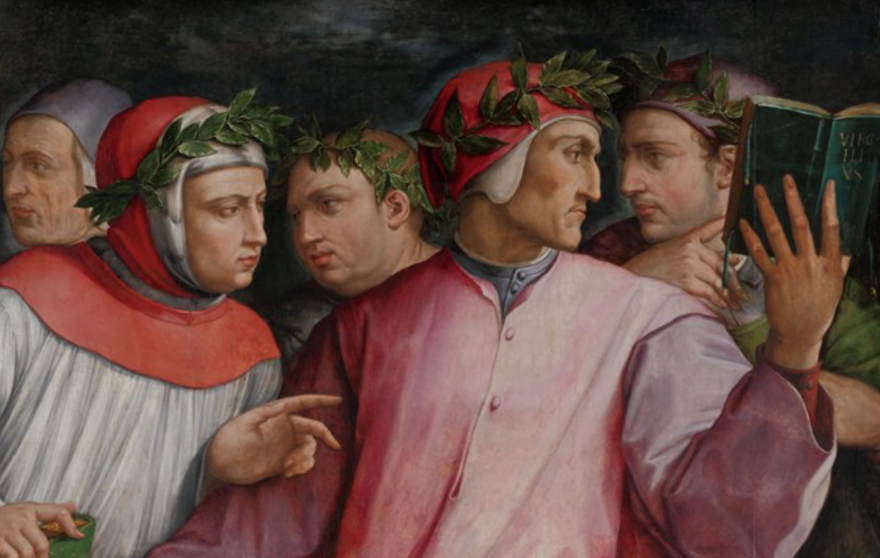
Here, we find Boccaccio nestled between Petrarch (to the left) and Dante (to the right) in Giorgio Vasari’s “Six Tuscan Poets.”
Boccaccio’s Decameron is frame tale story of 100 tales narrated over 10 days by a group of 10 in an attempt to cheer themselves during The Black Death (1346-53), the plague pandemic that was ravaging Italy. The brigata, or brigade of 7 women and 3 men, first meet at the Basilica of Santa Maria Novella in Florence, as the manuscript beautifully illustrated by Taddeo Crivelli (fl. 1451) shows.
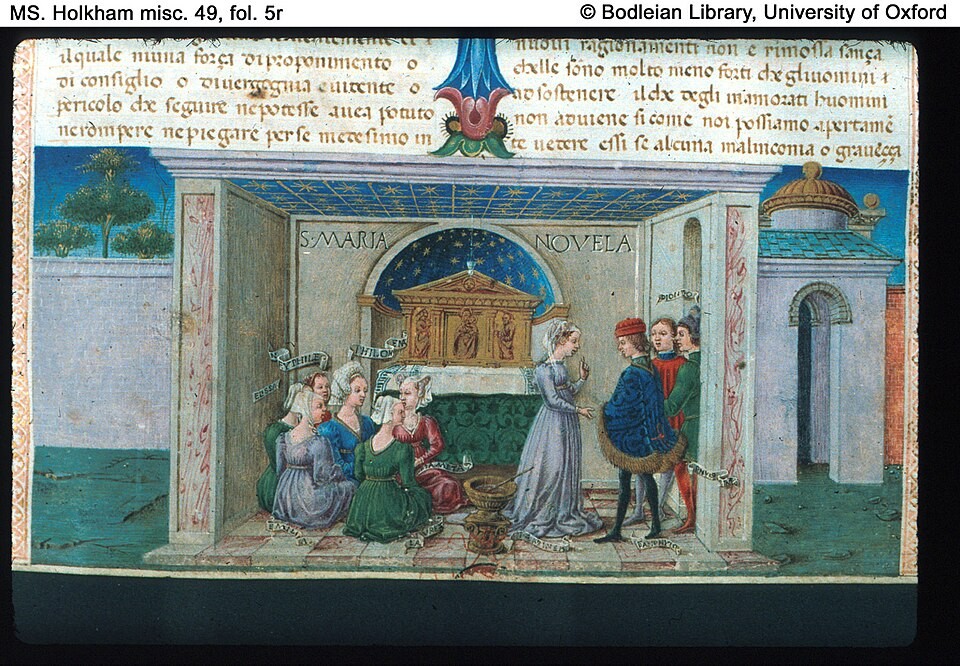
The Decameron, Giovanni Boccaccio, illustrated by Taddeo Crivelli (1467), MS. Holkham misc. 49, fol. 5r, Bodelian Library, Oxford
1352
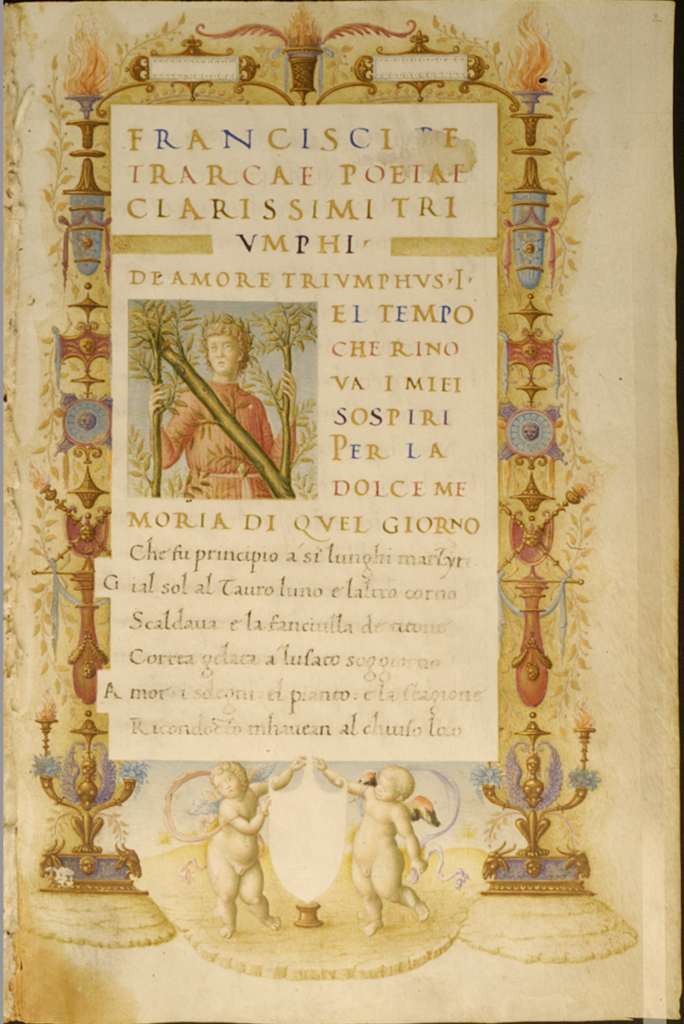
Bartolomeo Sanvito, “Portrait of Petrarch in the Incipit Letter ‘N,’” c.1480, W.755, ink and paint on parchment, The Walters Art Museum
Petrarch begins writing a second collection of vernacular poems, the Trionfi, or Triumphs.
TRIUMPHUS CUPIDINIS
Trionfo d'Amore
Al tempo che rinnova i miei sospiri
per la dolce memoria di quel giorno
che fu principio a sì lunghi martiri, (I.1-3)
TRIUMPHUS CUPIDINIS
Triumph of Love
THE SEASON when my sighing is renewed
Had come, stirring the memory of that day
Whereon my love and suffering began. (Wilkins)
1353
Petrarch returns to Italy.
1354
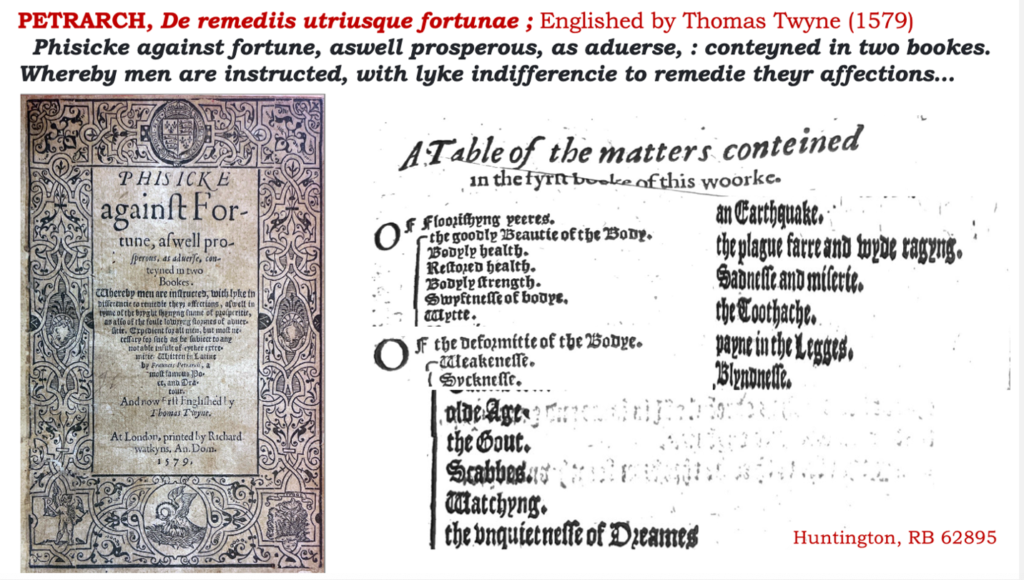
A copy of the “Englished” version of De remediis, from the Huntington Library, RB 62895. Taken during my time as a Dibner Research Fellow in the History of Science and Technology.
Petrarch writes a series of dialogues (254), titled De remediis utriusque fortunae (Phisicke Against Fortune, or Remedies for Fortunes), a work discussing good and bad fortune that he writes in a style and vein that recalls Seneca’s De remediis fortuitorum. Petrarch dedicates De remediis to Azzo da Correggio, Lord of Parma (1303-c.1362).
1357
After some conflicts and familial troubles, Petrarch sends his son, Giovanni, to Avignon. Giovanni had previously lived with Petrarch, who complains about his son’s irreverent behaviour in his letters.
1359
Petrarch starts organizing his Rerum familiarum libri (Epistolae familiars; Letters on Familiar Matters), a collection of 350 letters, dedicated to Ludwig van Kempen, written between 1325 and 1366, the idea that inspired him to do so being his discovery of Cicero’s letters in Verona’s Biblioteca Capitolare. (see year 1345).
1361
Petrarch begins transitioning from the Familiares. He begins a second collection of letters, called the Seniles, or Letters of Old Age. This collection consists of 18 books and 128 letters.
Petrarch’s son, Giovanni, with whom he had a very fractious relationship, dies of the plague at 25 years old.
Petrarch’s daughter, Francesca, marries Francescuolo da Brossano, who would become the executor of Petrarch’s will. Petrarch moves to Padova.
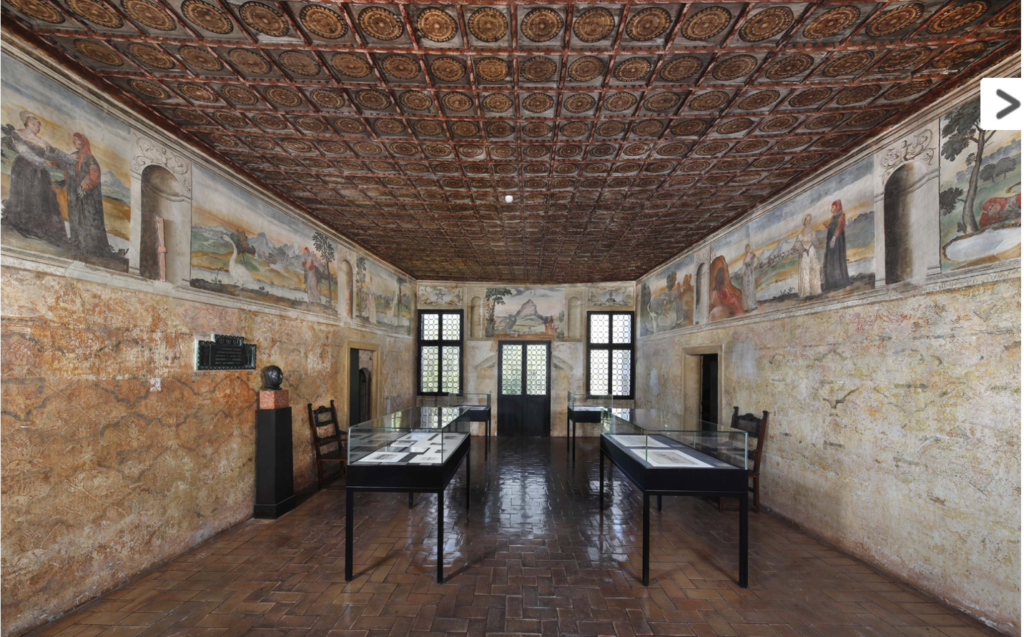
“Casa del Petrarca,” Comune di Padova, Settore Cultura e Turismo
1362
Petrarch and his daughter’s family moved to Venice.
Francesca and Francescuolo have a first child, a daughter, whom they name Eletta, after Petrarch’s mother.
1366
Petrarch finishes writing the Familiares.
Francesca and Francescuolo have a second child, a son named Francesco, who had an especially close and loving bond with his grandfather.
1367
Petrarch moved to Arquà, a province of Padova, in the Veneto region of northeastern Italy. It is in Arquà where Petrarch would spend the last four years of his life, and in 1870, Arquà would add Petrarch’s name to the town’s own, thus becoming “Arquà Petrarca.”
Petrarch begins writing De ignorantia (De sui ipsius et multorum ignorantia; On His Own Ignorance and that of Many Others), a complaint in which Petrarch offers a defense of his reputation and complains about the envy of others. He begins this text while travelling down the river Po towards Padova, and ultimately dedicates it to Donato degli Albanzani.
1368
Francesca and Francescuolo’s son, Petrarch’s beloved grandson, dies at only 2 years old. He is buried at the Parish of San Zeno, where Petrarch writes for him a moving epigraph, now located at the Castello Visconteo di Pavia. Petrarch reports being heartbroken by his grandson’s passing.
1370
Petrarch writes his last will and testament in Padova.
1374
July 19, Petrarch’s daughter Francesca discovers her father dead at his desk, while at work.
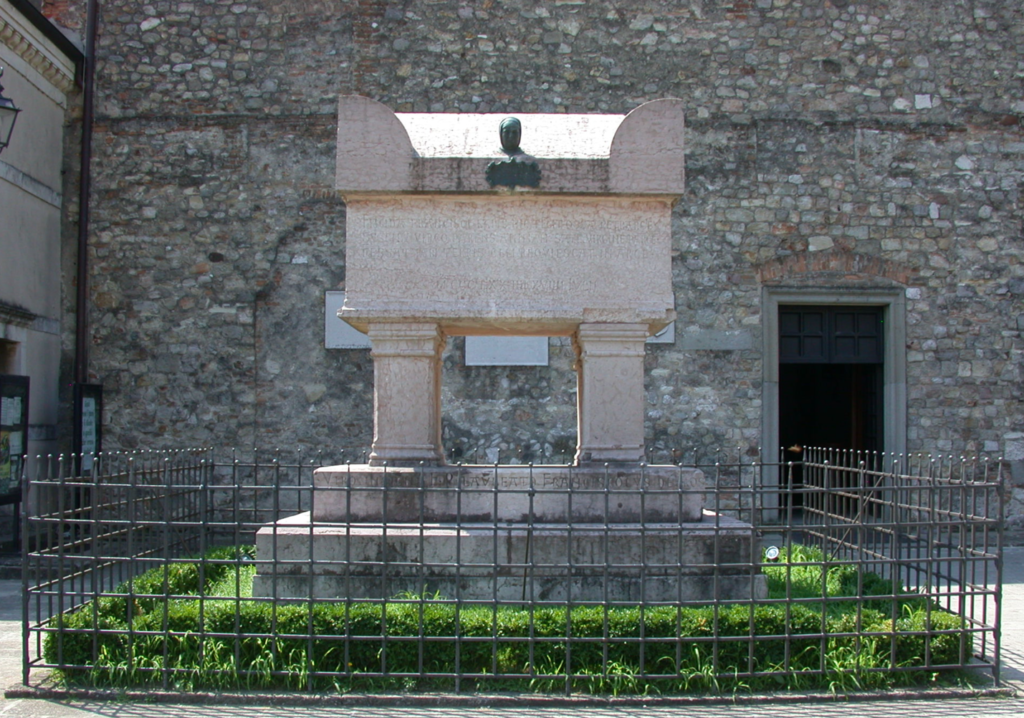
Petrarch was originally buried in their local parish church. His remains were later transferred to a tomb in Arquà (now at Piazza Petrarca or Petrarch Square); the tomb was built by Francescuolo da Bassano, Francesca’s husband and executor of Petrarch’s will.
The inscription on the tomb reads:
“Frigida Francisci lapis hic tegit ossa Petrarcae,
suscipe, Virgo parens, animam; sate Virgine, parce.”
“This cold stone here covers the bones of Francesco Petrarca. Receive his soul, Virgin Mother; and Virgin Mother, have mercy on him.”